A reproducible experiment in your browser
Watch a circuit learn.
Give a model of fly connections a task. Watch its choices improve, then change the wiring to find out what made the difference.
This lab uses a selected circuit and an engineered learning rule. It does not simulate an intact fly or demonstrate biological intelligence.
Does practice improve the choices?
Evaluation never updates the model. These observations contain fresh noise around the same cue identities used during training.
Activity inside the model
Each square represents a model cell. Brightness shows its computed response. This grid is a schematic, not an anatomical map or a recording from an animal.
Why this lab is useful
A learning curve needs an explanation.
Changing a connection is not enough to show that learning helped. This lab lets you repeat a task with learning disabled, or with the input wiring rearranged, while keeping the task and training budget the same. A saved model makes the experiment portable.
On a small screen, swipe across the figure or open it full size.
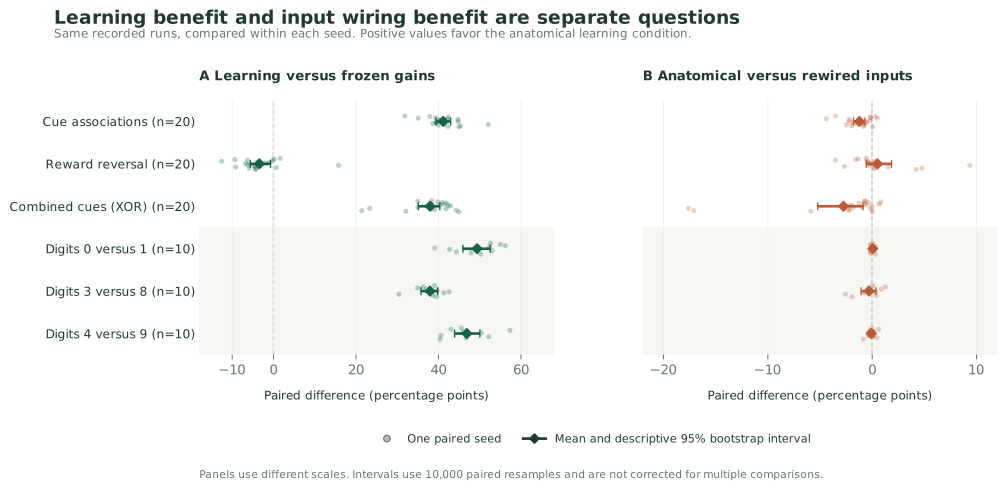
See the tasks behind the results
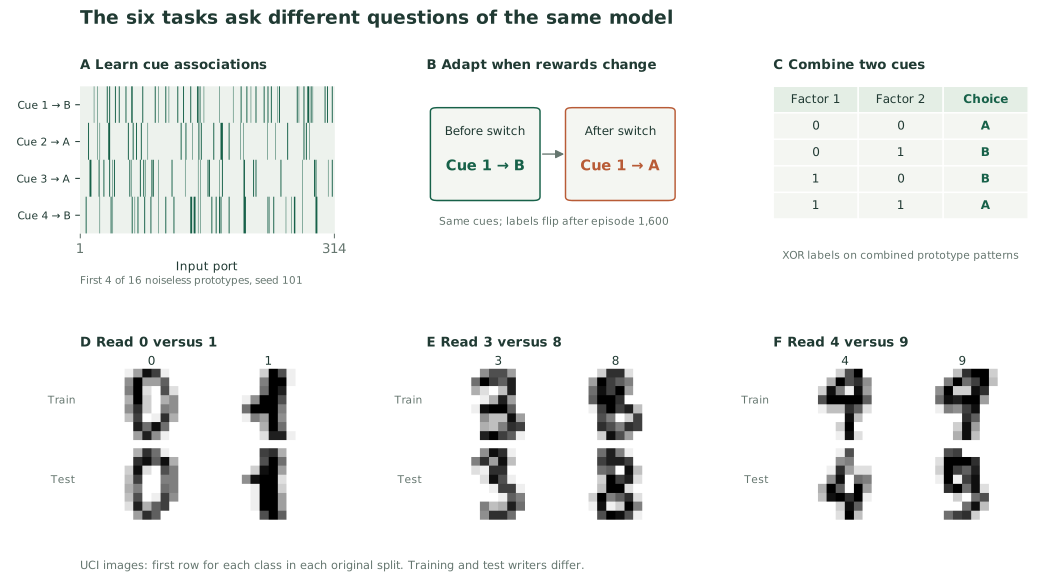
On a small screen, swipe across the figure or open it full size.
Loading the completed study.
These are computational experiments using synthetic sensory patterns, published handwritten digits and measured connectivity. They do not establish improved learning in people, biological accuracy, or superiority to modern machine learning systems.
Use these experiments in your research.
Start with a working comparison, then replace the task or learning rule. The source includes the completed runs and reproduction scripts, so you can compare a new result with the reported conditions. Cite this work when you use its software, protocol or results, and cite the original datasets for the data you use.
Citation and source attribution
Jiahe Tian. 2026. GFly: Reproducible Browser Experiments with Learning in a Fly Connectome. HiOS Labs Inc. hios.app/research/gfly/.
This is the public research manuscript and artifact. The reproduction bundle includes CITATION.cff and ATTRIBUTION.txt. The measured connectivity is from MaleCNS v1.0; handwriting data are from Alpaydin and Kaynak's UCI dataset.
What is measured, and what is designed?
The connection identities and synapse counts come from MaleCNS v1.0. This lab selects projection neurons, Kenyon cells and mushroom body output neurons that form a connected input to output path. It omits all other connections, including recurrent paths.
The response normalization, activity threshold, artificial action groups and learning rule are design choices. One gain for each existing Kenyon cell and action group scales that cell's connections to the group. A conventional policy gradient method changes these gains after feedback. No search algorithm selects candidate actions.
The game demonstrations at gfly.site are separate applications and can contain conventional game logic. Their behavior is not evidence for the learning results reported here.
Data: MaleCNS, Janelia and Google Research, CC BY 4.0. Related browser work includes Connectome Lab. The paper explains what this implementation adds and what remains untested. Handwriting images are from Alpaydin and Kaynak, UCI Optical Recognition of Handwritten Digits, CC BY 4.0.