Abstract
Browser demonstrations can show a connectome making useful choices without establishing what learned or whether the anatomical wiring mattered. GFly Learning Lab provides a compact, inspectable environment for answering these questions. It uses 80,404 connections from the MaleCNS release in a declared rate model with reward driven gains, matched wiring controls and portable experiment checkpoints. Across 360 runs on three synthetic tasks, the anatomical condition reaches 90.6% expected correct choice probability on cue associations and 88.2% on a combined cue task. It reaches only 47.1% after reward reversal within the specified adaptation budget. An additional 180 runs use published handwriting images with the original separate writer training and test partitions. The altered wiring controls learn successfully, so the experiments do not establish an advantage for the selected projection neuron to Kenyon cell input partners under this decoder. All 20 tested browser runs reproduce uninterrupted learning exactly after saving and restoring a checkpoint within the same engine. The contribution is a tested research and teaching artifact that exposes learning assumptions and supports repeatable comparisons. It is not a new reinforcement learning algorithm or evidence of biological brain emulation.
Test what makes the model learn.
A successful game or animation can hide the source of its decisions. This lab makes the learning mechanism inspectable. You can disable learning, change input wiring, or replace useful feedback with random rewards while keeping the task and training budget the same.
Training runs in your browser without an account, API key or installation. Save the learned state, reopen it in another session, and continue the same experiment. A programming guide shows how to define a new task with two possible actions.
A researcher can reuse the released circuit transformation and 540 run records as a comparison baseline, then test a different encoder, reward rule or model. The paired controls help establish whether an improvement depends on learning or the selected input partners. The saved state and continuation checks make that comparison inspectable by another person.
The intended users are researchers trying small decision tasks and instructors explaining experimental controls. Benefits to their productivity and understanding still require evaluation with independent users.
Open GFly Learning Lab · Read the programming guide
Measured results
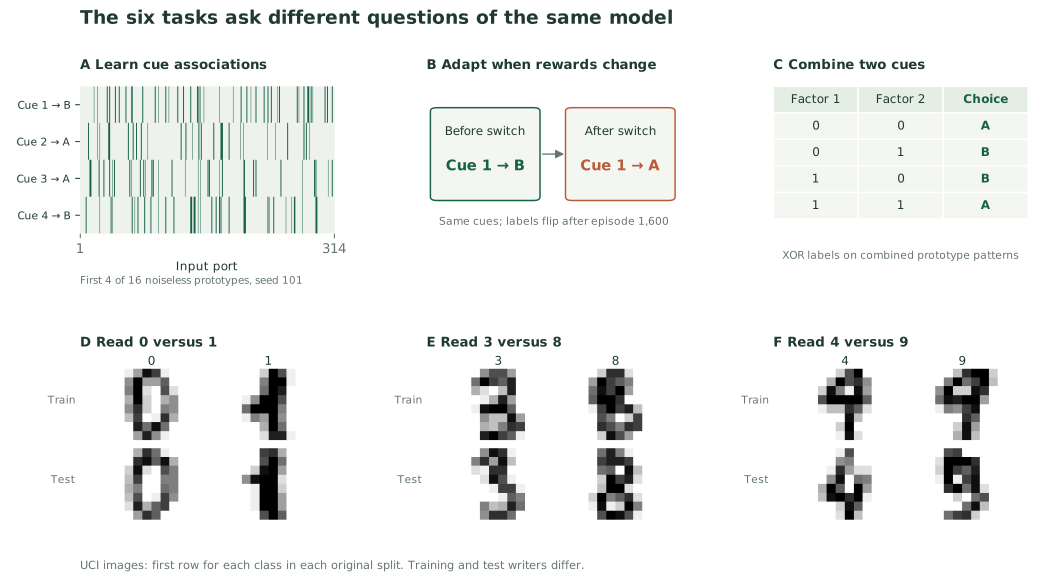
The paper reports 360 runs on three synthetic tasks and 180 runs on three binary handwriting tasks. Every task includes six experimental conditions. The handwriting experiments use the published training and test partitions with different writers.
| Synthetic task | Anatomical wiring with learning | Rewired control with learning |
|---|---|---|
| Cue associations | 90.58% | 91.81% |
| Reward reversal | 47.13% | 46.63% |
| Combined cues, XOR | 88.25% | 91.00% |
Mean expected correct choice probability at the final checkpoint across 20 seeds per condition. This measures the stochastic policy. The paper reports dispersion and descriptive paired comparisons.
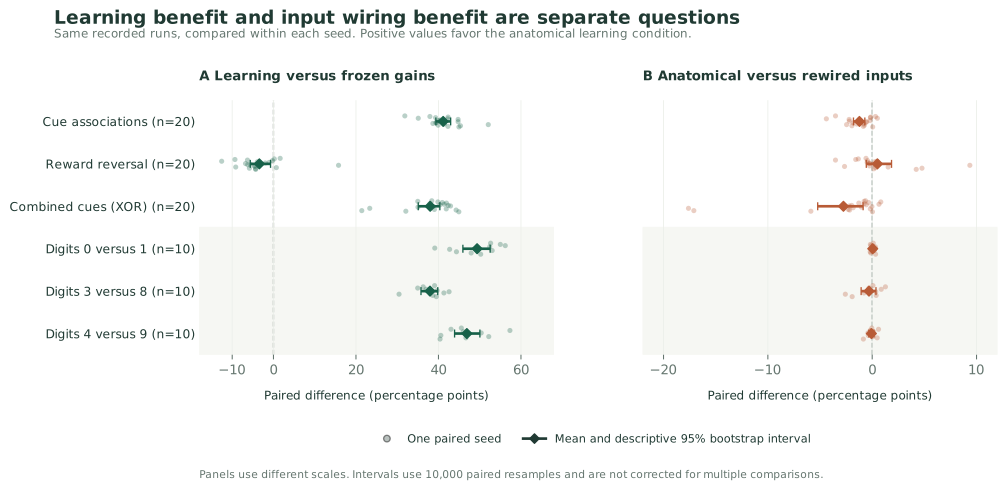
On handwritten 0 versus 1, 3 versus 8, and 4 versus 9, the anatomical condition has mean classification accuracy of 99.78%, 95.61%, and 98.59%. These numbers use the most probable action and average ten seeds. They are separate binary tasks, not a ten class handwriting benchmark. Altered wiring controls also learn successfully.
All 20 tested browser checkpoint continuations matched uninterrupted learning exactly within their engine. Independent numerical calculations also agreed with the implemented model. Browser verification used Chromium and WebKit on one computer; physical phone performance and energy use were not measured.
The failure to adapt after reward reversal remains in the results. The public bundle includes all experimental conditions, raw run records and reproduction instructions.
Paper and experiment files
The manuscript includes seven figures, the model definition, experimental protocols, results and limitations. The source bundle contains the code, selected circuit data, handwriting data, LaTeX source, recorded results and validation scripts, with attribution to the original datasets. The figure generator and its provenance record allow every plotted comparison to be traced to the completed runs.
Accessible manuscript · Run the lab on hios.app · Synthetic results · Handwriting results
Cite this research
Jiahe Tian. 2026. GFly: Reproducible Browser Experiments with Learning in a Fly Connectome. HiOS Labs Inc.
@misc{tian2026gfly,
  author = {Jiahe Tian},
  title = {GFly: Reproducible Browser Experiments with Learning in a Fly Connectome},
  year = {2026},
  month = oct,
  publisher = {HiOS Labs Inc.},
  url = {https://hios.app/research/gfly/}
}
Download BibTeX · Download RIS · Citation file for the software
Cite this research when you use its software, experimental protocol or results. The source bundle includes attribution for the original connectivity and handwriting datasets.
This is a public research manuscript. It has not undergone independent peer review. The paper describes its use of AI assistance and the limits of the completed evaluation.